Confidence built
into every decision.
Commercial mānuka supply needs more than a grade on a label. Testing, traceability and documentation must support the product, market and intended application.
Illustrative laboratory setting. Valid documentation is issued for the exact batch purchased.
Confirm the New Zealand mānuka classification.
Review applicable batch-specific laboratory evidence.
Maintain records through the commercial supply chain.
Align product and export evidence to the destination.
Testing and authenticity
New Zealand has a science-based regulatory export definition for mānuka honey. New Zealand's Ministry for Primary Industries (MPI) states that honey labelled as mānuka for export must be tested by an MPI-recognised laboratory against five attributes: four chemical markers and one mānuka-pollen DNA marker. The results are used to distinguish monofloral and multifloral mānuka honey.
For commercial buyers, this provides an important foundation for product specification and documentation. It does not replace destination-market requirements, which can vary by country and product format.
Authenticity
MPI's definition uses a combination of four chemical markers and a mānuka pollen DNA marker to authenticate New Zealand mānuka honey for export.
Batch testing
Validated laboratory results support the identification and certification of mānuka honey. For export consignments, the applicable batch documentation must align with MPI requirements.
Traceability
New Zealand's export framework includes requirements for traceability through the bee-product supply chain and supporting records.
Export documentation
Commercial supply may require certificates, laboratory results, product specifications and market-specific documentation. Requirements depend on the destination and application.
What commercial buyers should confirm
Before placing a bulk, private-label or OEM order, it is useful to establish the required mānuka classification, target MGO or other specification, pack format, batch documentation, destination market and intended application. These details help align the supply specification with the finished product and export pathway.
For private-label and OEM projects, quality documentation can also form part of the product-development process, alongside packaging, labelling and destination-market requirements.
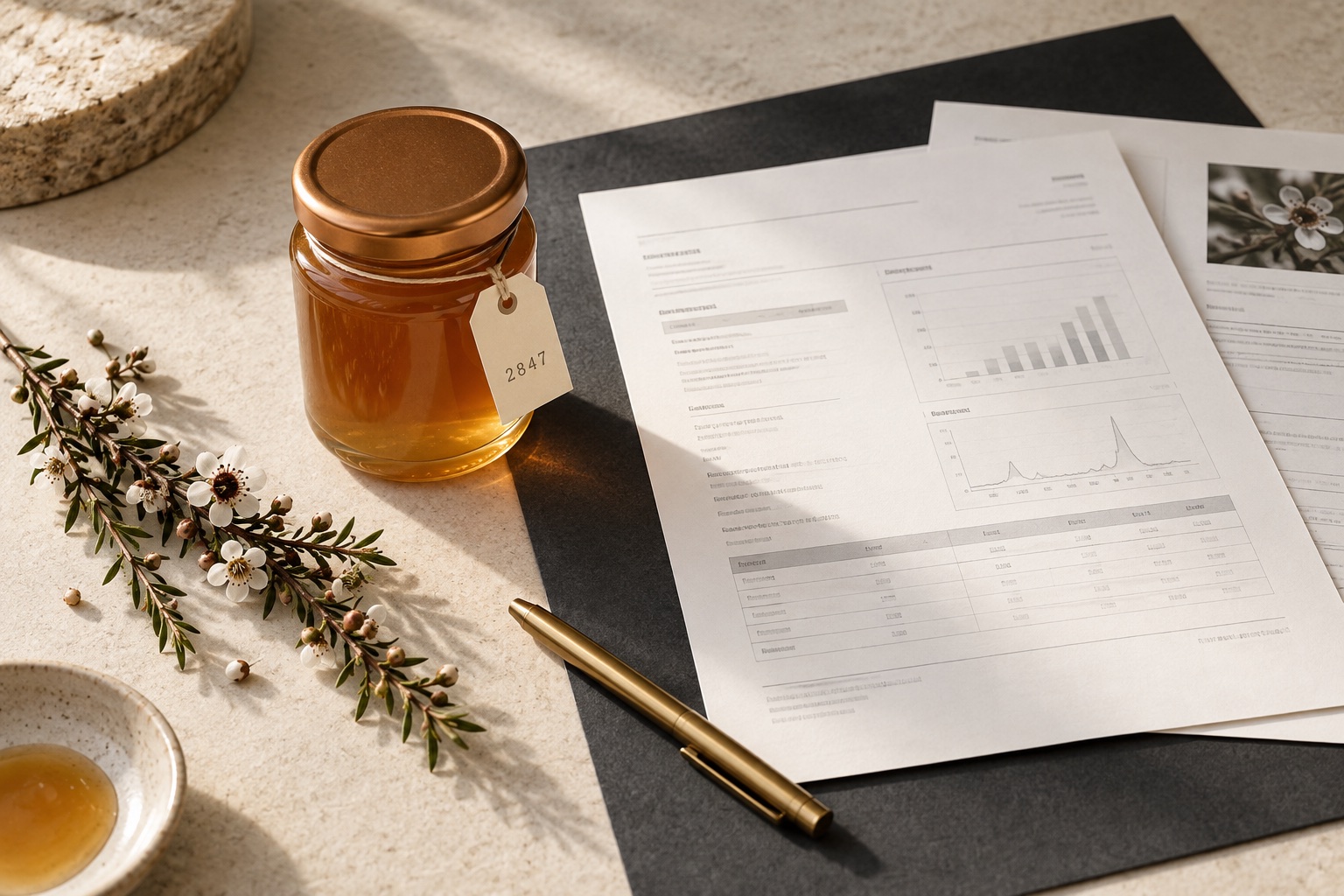 Illustrative batch-documentation setting
Evidence should travel with the honey.
Every exported Manuka Solutions honey shipment is supported by a batch-specific certificate of analysis from Hill Labs, an independent accredited New Zealand laboratory. At minimum, the analytical scope covers DHA, HMF, MGO, NPA and leptosperin, together with report identifiers, method information and authorised laboratory sign-off.
Access the representative COA guide →The website document is clearly marked SAMPLE ONLY. The valid laboratory-issued COA is supplied for the exact batch purchased.
Define the evidence before committing to supply.
Tell us the market, application, grade, format and volume. We will help identify the testing and documentation pathway around the requirement.